


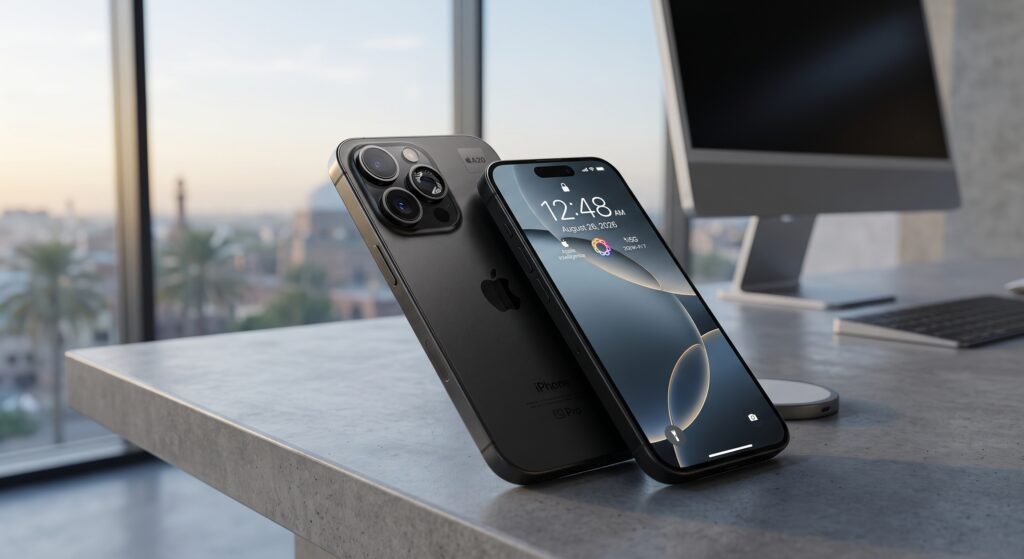
Each new iteration of iPhones is always surrounded by supply chain rumors, early leaks about the components, and even mockups of the product. The iPhone 18 series, however, seems to have its own kind of hype happening in the technology world. For a long time, the iPhones were only getting marginal changes and improvements in design and features, but now Apple seems to be setting out on some groundbreaking architectural shifts.
What people are talking about when it comes to iPhone 18 is not about a bit thinner bezel or slightly different camera. Instead, the leaks from the supply chain, the analyst reports of tech watchers like Ming-Chi Kuo and Jeff Pu, and the patent filings suggest that Apple is going to make its first ever foray into the 2-nanometer chip making process, release variable aperture lenses mechanically, create custom silicon modems, and change its release schedule completely.
From considering an upgrade from your old phone, following the ambitions of Apple to develop ever more sophisticated on-device AI capabilities, to just distinguishing actual hardware rumors from speculative nonsense, it takes some contextual knowledge. This overview focuses on the timing of the product launch, screen technology, A20 chip, camera hardware, battery technology, software considerations, and price positioning of the complete iPhone 18 family.
iPhone 18 Release Date: Breaking the Traditional Playbook?
It has now been over a decade since the scheduling of the iPhone for your calendar was a relatively easy process. From the iPhone 4S in 2011 to date, Apple has been reliably holding its major keynote where the phone is concerned in early to mid September, pre-orders being made available just a day after the event.
According to recent supply chain information, that could all change with the iPhone 18 series.
- Pro iPhone 18
- Normal iPhone 18
- Pro Max iPhone 18
- iPhone 18 e
- First Foldable Phone
- Secondary Line Refresh
Several separate reports indicate that Apple is considering a split release strategy. In accordance with this reported approach:
- Fall 2026 Release Window: Apple would kick off its typical September event with its flagship lineup featuring the iPhone 18 Pro, the iPhone 18 Pro Max, as well as its much speculated about ultra flagships, the foldable iPhone.
- Spring 2027 Release Window: The iPhone 18 base model along with lower-tier variants like the iPhone 18e would be released in an early spring release window.
Why Would Apple Bifurcate the Lineup?
There are multiple practical and business reasons for this move. The first is that of the bottlenecks in cutting-edge chip production. Getting enough chips produced at TSMC’s cutting-edge 2nm process technology is notoriously tricky. Focusing on the Pro lineup allows Apple to allocate its limited early silicon resources to its most profitable products without compromising baseline supplies.
Secondly, splitting the launch allows Apple to sustain its retail momentum throughout the whole year rather than have a spike in revenue during one particular fall launch event. It is similar to how the iPads and Macs get their staggered launches depending on the readiness of components.
The Unknown
No news about changing the launch plans from Apple has surfaced. Despite the increased rumors in the supply chain of splitting the launch, yield improvement from TSMC or changes in the competitive landscape could just as well force Apple to revert to a single September launch of all the models. Until the keynote invites come out, it can only be considered an educated guess depending on component manufacture timelines.
iPhone 18 Models: How the Lineup Is Taking Shape
Apple’s flagship tier line-up has always been under constant evolution. We have seen the development of its lineup through Plus variations, mini versions, and the addition of extra thin tiers.
However, when it comes to the iPhone 18 series, the tier line-up seems intended to further increase the technology gap between utility and enthusiasts.
The Standard iPhone 18
The baseline device is likely to have all the key elements of design of the latest iPhone while adding necessary baseline enhancements. It will serve those consumers who seek reliable daily phones taking advantage of new platform innovations like front-facing cameras and increased baseline memory without having to spend $1,000+.
The Pro and Pro Max Tiers
The iPhone 18 Pro and 18 Pro Max will be Apple’s guinea pigs when it comes to pushing forward in components. Instead of having the same hardware but just differentiating themselves through battery capacity and display sizes, these phones will supposedly be the only ones that will benefit from Apple’s latest wafer packaging technology and camera hardware.
Design and Display: Subtle Changes with Tangible Impact
In all probability, the new iPhone series will not deviate significantly from the existing industrial look which has been adopted over the last few generations. Apple never discards a successful industrial design too soon and prefers ergonomic changes over revolutionary changes in aesthetics. Yet some changes may be introduced mechanically and by panel improvements.
Dynamic Island and Bezel Refinements
Display supply chain analysts such as Ross Young have been following the Apple roadmap regarding the transition of TrueDepth sensor hardware under the active display layer. Though an invisible under-display camera is impossible at present because of light transmission loss, it has been reported that the upcoming iPhone 18 Pro will offer a notably smaller Dynamic Island.
The reason behind this is that by relocating the ambient light and proximity hardware under the active OLED matrix, the company would be able to shrink the cutout size. The practical impact of this would be lesser intrusion of the letterboxing effect while viewing 21:9 video content.
OLED Advancements and ProMotion
Display technology across the lineup is expected to mature:
- LTPO+ Displays: LTPO+ displays will be utilized in both the Pro and Pro Max versions, and their benefit is reduced energy consumption when rendering AOD elements at 1Hz.
- Maximum Peak Brightness: Despite the fact that the current flagship smartphones can withstand direct sunlight fairly well, the information from supply chain sources indicates that Apple is trying to reach greater outdoor nit numbers to resist reflections and offer improved HDR master previews.
- Standard Version Refresh Rate: Perhaps, one of the most common issues faced by consumers is the fact that standard iPhones have a maximum refresh rate of 60Hz. Competing mid-rangers might force Apple to make 120Hz ProMotion a universal standard, but there is always the possibility that the company will differentiate Pro and non-Pro models with panel-driving limitations.
Materials and Durability
Durability is still an issue that cannot be ignored. In light of the user feedback related to heat dissipation of the frame and durability against scratches in the brushed alloy, Apple is working on improving their chassis treatments.
It is believed that Pro versions will be using structural aerospace grade frames with thermal bonding for heat dissipation from the main logic board.
iPhone 18 Performance: The 2nm A20 Milestone
For decades, the raw processor performance benchmark has surpassed the needs of regular mobile use cases. You do not require a beast of multi-core computing power for social scrolling, email replies, or video streaming. The true worth of Apple’s next-gen silicon, which is expectedly called A20 and A20 Pro, is architectural efficiency, thermal budget, and ML compute capability on device.
The Transition to TSMC’s 2nm Node
The first technological breakthrough that the A20 family makes is switching to TSMC’s 2-nanometer (N2) manufacturing technology. The change shifts away from traditional FinFET transistors to GAA nanosheets.
Namely, surrounding the channel with conductive material from all four sides results in significantly lower leakage. This enables the chip to function with increased frequencies without much heat generation or switch to very low-power modes while operating in a standard way without discharging the battery.
WMCM Packaging and Memory Architecture
Wafer-Level Multi-Chip Module packaging is another key improvement being mentioned by the analyst Ming-Chi Kuo. Apple is said to be adopting Wafer-Level Multi-Chip Module packaging technology.
Traditionally, DRAM memory chips were positioned next to the SoC chip and connected using traces on the circuit board. In contrast, WMCM technology allows incorporating system memory on the same substrate.
This is important because reducing the distance from the cores, Neural Engine, and memory means that memory latency will be greatly reduced while bandwidth increases.
How this helps: LLMs operating on the device require efficient memory access. Thanks to WMCM architecture, AI processes can process the tokens locally without turning the phone into a pocket heater.
Gaming and Sustained Loads
From simple 2D mobile games to advanced console-grade mobile games that utilize ray tracing on hardware, mobile games have certainly evolved. The major issue with high-performance mobile games is not reaching the maximum frame rates within the first couple of minutes but thermal throttling for up to thirty minutes. The efficiency of the 2nm technology along with the revamped internal heat spreaders should help to achieve that.
5. Camera Upgrades: Mechanical Control Meets Computational Optics
Smartphone cameras have reached their optical limit. Since it is not possible to put a substantial amount of glass into a sensor in order to avoid unreasonably bulky camera bulges, smartphone makers had to rely on software-based compensation for physical constraints.
The iPhone 18 Pro line of smartphones seems likely to break the barrier through the return of mechanical optics.
The Introduction of Variable Mechanical Aperture
According to expert analyses, the main 48 megapixel sensor of the iPhone 18 Pro will feature variable physical aperture optics. Instead of having only one aperture and adjusting the exposure time and ISO settings electronically, physical aperture blades can become larger or smaller:
- Photography in Low Light Conditions: A wider aperture enables more light gathering by the sensor in a natural way, resulting in less noise processing and true shadows being captured.
- Macrophotography: Wide fixed aperture lenses have very thin depth of field, and the borders of the document or macro object appear too blurry. Decreasing the aperture results in a deeper depth of field and sharpness of the whole object.
- Video Filming: Cinematographers can have much more control over shutter angles and motion blur during filming in bright daylight without the use of clip-on ND filters.
Front Camera and Optical Array Refinements
Even the secondary camera and the front camera are finally getting some love. Reports indicate that there will be a new 24-megapixel front camera across the series, upgrading from the previous old and less powerful modules. This brings about sharper video framing in Center Stage, sharper FaceTime video calls, and sharper portrait separation.
In terms of computational photography, the Photonic Engine from Apple is supposed to take advantage of the extra bandwidth in the Neural Engine to do multi-frame zero-shutter-lag exposures with more realistic dynamic range than the over-sharpened “flat” pictures we have been seeing in recent years.
6. Battery Life, Thermals, and Charging Infrastructure
No matter how fast the processor is or how many pixels there are on the display, it is always the runtime of a device that determines the actual user satisfaction. Apple has always been staying away from the mAh competition in Android devices and was focusing on vertical integration of hardware and software for optimal performance.
Expectations of Run Time in Reality
Although the physical size of the housing defines how much physical power could be packed inside the battery, the performance of the 2nm A20 will play an important role in the everyday run time.
The background processes, network handshakes, and screen idles will consume less power. The average user should have a buffer for a few hours in case of a difficult day, not having to charge by midday.
Charging Dynamics and Thermal Throttling
Increases in the speed of wired fast-charging are projected to be conservative in nature and are likely to top out at around 40W using compatible USB-PD bricks. As far as Apple is concerned, they will always opt for cell longevity rather than 100W+ charging technology used by their competitors.
Wireless MagSafe and Qi2 charging will likely stay at the same 25W cap thanks to improved internal shielding.
7. AI and Software: How Apple Intelligence Integrates with Hardware
Modern-day flagship software is characterized by the predominance of artificial intelligence. Nonetheless, the approach that Apple takes using Apple Intelligence is completely different from those taken by its cloud-based rivals. The company still prioritizes privacy and performs all computations locally.
Siri and Semantic Context
With more system-level capabilities being implemented in latest iOS releases, Siri is evolving into a conversational assistant that is able to take multi-stage actions inside native and third-party apps. iPhone 18’s hardware, particularly the memory organization of the A20 processor, makes it possible to perform semantic analysis locally without any noticeable latency.
Creative and Everyday Utility
Rather than pushing AI as an isolated novelty, Apple is embedding machine learning into routine utilities:
- Real-time audio transcription and text generation: Real-time processing and summarization of multi-participant meetings or conversations using Notes and Voice Memos apps.
- Generation of context-based images and clean up: Removal of any distractive elements in photos or creating variants of images using local diffusion models without uploading photos to remote servers.
- Predictive workflow automation: Siri will predict the user’s actions depending on location, currently used app, and recent conversations, providing context-based suggestions without searching for them.
8. The Biggest Expected Changes: What Actually Matters
Cutting through the technical jargon, here are the meaningful upgrades expected on the iPhone 18 and how they translate into everyday use:
- TSMC 2nm A20 Architecture: Switching to the Gate-All-Around nanosheet architecture results in more efficient performance, decreased thermal throttling, and increased battery life when used throughout the day.
- Integrated Memory-Capable Packaging (WMCM): Achieves instantaneous on-device AI answers to Siri, local transcription, and smart summaries without draining the battery.
- Mechanical Variable Aperture (Pro Models): Provides realistic optical bokeh effect, sharper macro photos, and enhanced exposure control during bright sunny days without any digital artifacts.
- 24MP TrueDepth Front-Face Camera: Improves picture quality on video calls, selfies, and framing.
- Apple C2 Modem: Improves cell reception even in far-flung locations and increases efficiency of the battery when using mobile data over an extended period.
9. Final Verdict
Indeed, the smartphone industry has matured. While the period of iPhone launches that included major breakthrough design changes every year has passed into history, there is now a period of intensive engineering development in place.
Indeed, the value of the iPhone 18 series lies not in fancy features, but in its technological core that lies behind the shiny cover made from glass and aluminum. The arrival of 2nm semiconductor technology, modular wafer packages, proprietary communication chips, and physical variable optical controls marks a new technological breakthrough.
For people who use older iPhones for more advanced purposes than calling and texting, the iPhone 18 is likely to prove to be a really well-developed product for the coming decade.