


Introduction
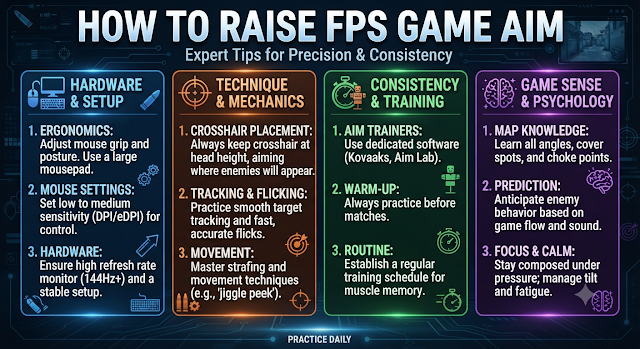
First-person shooter (FPS) games’ most essential talent is aim. Your aim decides how many battles you win and how swiftly you improve whether you play PUBG Mobile, Call of Duty: Mobile, Valorant, or Counter-Strike 2.
Though you have the finest strategy, positioning, and weaponry, if your target is off you will lose gunfights. The good news is that direction is a learnable talent. With the right techniques, appropriate settings, and regular practice, anyone can get better.
This thorough guide covers all you have to know about enhancing aim, including sensitivity, muscle memory, workouts, errors, psychology, and sophisticated methods used by elite players.
Grasping What “Aim” Really Is
Most gamers believe aim is just crosshair movement and firing. Aim actually results from a number of several distinct competencies operating in concert.
These include:
- Crosshair positioning
- Following
- Flicking of the flicking mechanism
- Response time
- Recoil control
- Target change
- Fine adjustments and precision
Enhancing aim requires enhancement of every aspect of it.
Muscle Memory: The Science Behind Aim
Good aim depends on muscle memory. Your brain is studying exactly how far to move your hand, finger, or device to get your crosshair on a target.
Your brain creates neural paths as you perform the same movement several times. One day, aiming becomes instinctive.
This is the reason why professional players seem so precise. Their brain already knows the specific movement needed.
Muscle memory calls for:
- Regular sensitiveness
- Consistent training
- Repetitiveness
- Time
Switching sensitivity frequently wipes off muscle memory.
Consistency is essential.
Step 1: Locate the Appropriate Sensitivity
Your crosshair’s speed is dictated by sensitivity.
Should sensitivity be too great:
- Aim wavers.
- Difficult recoil management.
- Hard to aim at little objects.
If sensitivity is too little:
- Slow react.
- Hard to follow fleeing foes.
The aim is balanced sensitivity.
Finding Your Ideal Sensitivity: Directions
Follow this straightforward test:
- Enter training mode or practice range.
- Aim at a goal.
- Follow a moving opponent.
Crosshair overshoot implies sensitivity too great.
Crosshair lags behind implies too low sensitivity.
Gradually change in little amounts.
Never significantly alter sensitivity.
Step 2: Excel in Crosshair Alignment 🎯
The quickest approach to raise accuracy is crosshair location.
Keep your crosshair where foes are probably to show up rather than trying after observing one.
Always pursue:
- Head Level
- Angles
- Doors
- Windows
- Common enemy stances
This lowers the distance your crosshair must travel.
Crosshair placement is critical for professional gamers.
Example
Poor player:
- Crosshair angled down
- Views opponent
- Crosshair moves up
- Late shoots
Decent player:
- Crosshair already at head level
- Enemy seems to
- Instantly shot
Great contrast.
Step 3: Learn Tracking
Tracking involves gracefully following a moving foe.
Automatic weapons need this.
Games needing monitoring are:
- Apex Legends
- Overwatch 2
- Call of Duty: Warzone
Ways to help with tracking:
- Exercise smooth targeting of moving targets.
- Do not overcorrect.
- Emphasize fluid motion over speed.
Tracking gets better with experience.
Step 4: Conquer Flicking
Flicking is quickly directing your crosshair to a target.
In tactical shooters such as Valorant and Counter-Strike 2, this is absolutely necessary.
Ways to refine flicking:
- First, concentrate on precision.
- Speed comes later.
- Work on little flicks.
- Afterwards, work on bigger flicks.
Speed comes second to accuracy.
Step 5: Reduce Reaction Time
Your response speed is dictated by your reaction time.
Quicker reaction time enables quicker shooting.
Ways to speed up response time:
- Do regular practice.
- Get an adequate amount of sleep.
- Keep your attention on something.
- Lower distractions.
Reaction gets better with experience.
The Ultimate Guide
In the world of First-Person Shooter games aim is the important skill to master. Whether you are playing Valorant or Counter-Strike 2 or trying to survive in Apex Legends, your ability to aim at an opponent is what decides if you win or lose.
You can have a strategy and the best weapons. If you miss your shot you will lose. This is because a good strategy and good weapons are not enough to win a game. You need to be able to aim to use them effectively.
The good thing is that aiming is a skill that you can learn with practice. It is not about being lucky or good at it. With the setup and practice anyone can get better at aiming. In this guide we will tell you everything you need to know to improve your aim in First-Person Shooter games like Valorant and Apex Legends.
What Does “Aiming” Mean?
Most people think aiming is just pointing at an enemy and clicking. It is actually a combination of many skills that work together.
- Crosshair Positioning: Putting your aim where the enemy is likely to appear.
- Tracking: Following a moving target with your aim.
- Flicking: Quickly moving your aim to a target.
- Recoil Control: Controlling the kickback of your gun when you fire.
- Reaction Time: How fast you can react to an enemy on the screen.
- Micro-adjustments: Small movements you make to get your aim just right.
To get better at aiming you need to practice each of these skills.
Muscle Memory: The Science Behind Aim
Aiming is mostly about muscle memory. When you move your mouse or controller your brain calculates how to move your aim on the screen. If you do this times your brain starts to remember the movement and it becomes automatic. This is why good players can aim well. Their brains already know the movement.
To build muscle memory you should:
- Stick to one sensitivity setting. If you keep changing it you will forget what you learned and have to start over.
- Practice every day even if it is for a time.
- Focus on repeating the movements over and over to build up your speed.
Step 1: Find the Right Sensitivity Setting
The first step to improving your aim is to find the right sensitivity setting. This setting controls how fast your aim moves when you move your hand.
- If sensitivity is too high: Your aim will be shaky and hard to control.
- If sensitivity is too low: Your reactions will be slow. It will be hard to turn around.
How to Test Your Sensitivity:
- Go to a practice range or training mode.
- Pick a target.
- Try to keep your aim on it while moving side to side.
- Try to follow a moving target.
💡 Tip: If your aim keeps going past the target your sensitivity is too high. If your aim is slow to follow the target your sensitivity is too low. You should adjust the setting in increments until it feels just right.
Step 2: Master Crosshair Placement
The single fastest way to immediately boost your kill count is improving your crosshair placement. This means keeping your reticle at head level and aligned with common enemy angles before you even see anyone.
Where to Always Keep Your Crosshair:
- Head Level: Never let your crosshair drag along the floor or look at the ground.
- Common Sightlines: Doors, windows choke points and popular holding angles.
Poor vs. Great Crosshair Placement
- ❌ Poor Player: Walks around looking at the ground spots an enemy drags crosshair and shoots late and gets eliminated.
- ✅ Great Player: Walks around with crosshair already at head height enemy steps into view. Pulls the trigger instantly without adjusting.
Step 3: Develop Smooth Tracking
Tracking is the ability to keep your crosshair glued to an enemy while they are moving. This skill is critical in high-TTK shooters like Apex Legends, Overwatch 2 and Call of Duty: Warzone, where you must land continuous shots.
Tracking Best Practices:
- Prioritize Smoothness: Focus on continuous arm or wrist movements rather than jittery corrections.
- Don’t Overcorrect: If you fall behind a target gently adjust than violently snapping back and forth.
- Practice Without Firing: Spend time in training modes keeping your crosshair locked on moving bots without shooting.
Step 4: Hone Your Flicking Precision
Flicking is the action of snapping your crosshair onto a target that appears outside your active focal area. It is vital in shooters like Valorant and CS2 where a single headshot decides the outcome.
How to Refine Your Flicks:
- Focus on Accuracy First: Speed is a byproduct of accuracy. If you try to flick fast before mastering control you’re only training yourself to miss quickly.
- Start Small: Practice short precise micro-flicks onto nearby targets.
- Expand Range Later: Once short flicks are consistent start practicing flicks across your screen.
Step 5: Sharpen Your Reaction Time
Your reaction time measures how quickly you process information and execute a physical response. While genetic limits exist you can maximize your baseline reaction speed with habits:
- Eliminate Distractions: Keep your full cognitive focus on the active screen area.
- Get Adequate Rest: Physical fatigue severely degrades motor skills and mental processing speed.
- Warm Up: Never jump straight into ranked matches spend 10–15 minutes firing up your reflexes in a warm-up mode or aim trainer.
Summary Checklist to Upgrade Your Aim Today
| Focus Area | Core Action |
| Sensitivity | Choose a setting and never change it frequently. |
| Crosshair Placement | Keep your crosshair at head level. Pre-aim angles constantly. |
| Muscle Memory | Practice short deliberate warm-up routines. |
| Mechanics | Work on tracking for movement games precise flicks for tactical games. |
| Mindset | Prioritize accuracy and control over speed—speed will come naturally. |
Conclusion
By breaking aim down into these components and building disciplined habits you will notice a dramatic difference in your confidence and performance in every gunfight. See you at the top of the leaderboard in First-Person Shooter games, like Valorant and Apex Legends.